

In this issue
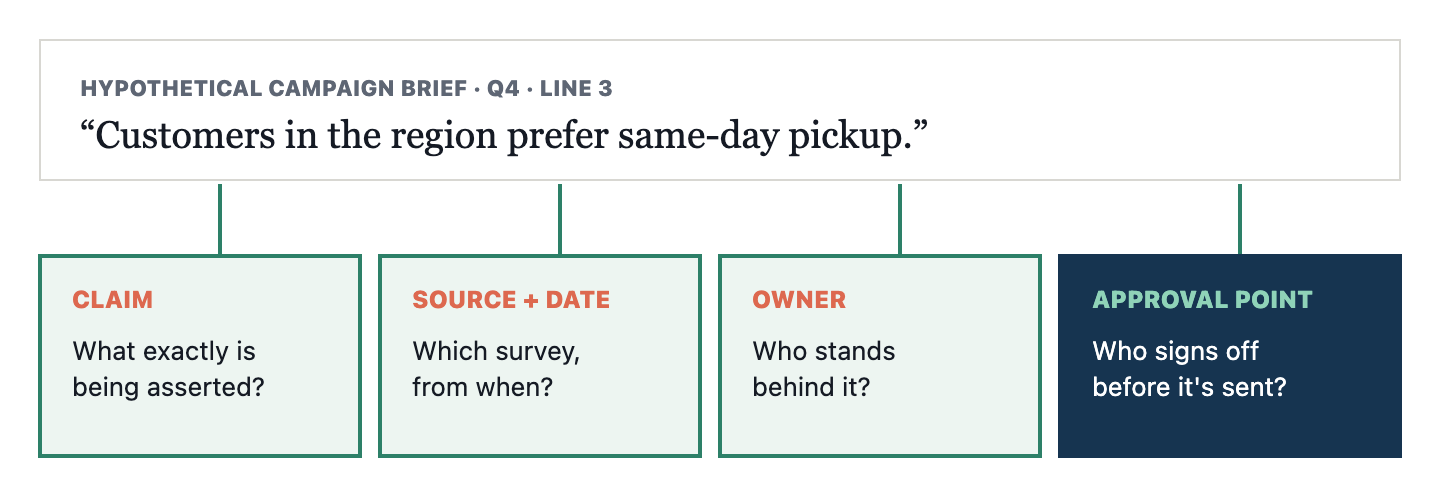
Picture a campaign brief landing in your inbox an hour before a client call. It's beautifully formatted, the headlines are sharp, the tone is confident. One line says customers in the region prefer same-day pickup.
It's a hypothetical, but you've seen the real thing. So: where does that line come from? Nothing on the page tells you. And that's increasingly the job. Not making the draft. Checking it.
Signal one
Fluency is cheap. Verification is the value.
One of the stories we followed was an informal research essay by a former OpenAI researcher who studies what happens inside individual neurons in language models. In one experiment, he deliberately removed only the strongest signals from a model's neurons and left everything else alone. In that altered state, the model couldn't recite famous texts it normally knows. Asked for the opening of the American Declaration of Independence, it wrote a declaration for a country that doesn't exist: the Republic of Luzang, breaking away from the Philippines.
To be clear, that was a deliberately altered model in a lab, not how a chatbot normally behaves. The researcher's point was about where memorized text lives inside a model. But the lesson for client work is hard to miss. The model's knowledge was damaged, and its output was still fluent, still structured, still perfectly confident. The polish told you nothing about whether the facts were there.
From our own production
Here's the part I didn't plan to write about. The first AI-generated draft of this episode's audio told the Luzang story too, and got it wrong. It credited the example to the wrong company and explained it as everyday hallucination. It sounded polished. It was wrong.
We caught it because that draft was transcribed and every claim checked against the source transcripts before anything was published. The corrected scripts were checked again, and each final recording was transcribed back and compared with its script. That's the same discipline this edition is about, applied to ourselves.
Signal two
The work doesn't disappear. It turns into review.
So does AI actually save effort once review is included? The sources don't give a measured answer, but they show where the effort moves. In coverage of Google's Gemini 4 Argon launch, a Google Antigravity engineer described localizing more than a hundred pages of their website into seventeen languages in about two days. Notice what he kept: native-language humans still spot-check the translations. His framing was that instead of translating by hand, which can take weeks, people now review.
Newer examples point the same way. In OpenAI's customer stories, AT&T's in-house legal team described new matters arriving with their history and suggested first steps already attached, while “the decision-making will always remain with the lawyers.” Thomson Reuters framed the goal as judgment that is cited and verifiable: something a professional can trust and put their name on. These are vendor showcases, not audits. But notice that neither one sells the draft. Both sell the review.
Review only saves time if it's structured. Otherwise you've swapped writing fatigue for editing fatigue: the draft shows up in seconds, and then the afternoon disappears into checking it. One writer described a structure worth borrowing: before publishing, he has several AI threads each try to prove the draft wrong, then runs a separate pass that finds a primary source for every number he mentions. The machine does the doubting. He still makes the call.
Our own publishing taught the same lesson. A polished HTML draft didn't automatically become a finished platform edition; visual assets, captions, tables and mobile readability all still needed attention. And the roundup behind these editions is built each week from a myriad of channels and feeds. The volume is what makes a structured check non-negotiable.
Signal three
Proposals and decisions should never look alike
The most expensive confusion in client work is a proposal that reads like an accepted decision. Keep them visibly distinct in the layout, not in a footnote, so your reader never has to ask which one they're looking at. And keep one canonical version of the deliverable; the hour spent working out which file is the real final is the hour nobody bills for.
| A proposal | An accepted decision | |
|---|---|---|
| How it reads | “We recommend…” | “Approved on [date] by [owner]” |
| Who can change it | The author | Only the decision owner |
| How it looks | Clearly marked as draft | Clean, with date and owner attached |
| What the reader does | Weighs it | Acts on it |
If your reader can tell a proposal from a decision at a glance, you've already removed the most common source of client rework.
A founder described a neat version of this inside his own company. Twice a week, an AI agent proposes the main bottleneck for each business, posts it to the team channel, and tags the people involved. They reply if they agree. If they don't, that's where the conversation starts. The agent proposes; people decide.
For your role
Make it yours
- If you consult: this is an easier conversation than selling a client on autonomy. You're showing where judgment stays and what evidence sits between a draft and a recommendation.
- If you run delivery or accounts: the handoff that breaks is rarely the big one. It's the status update nobody owns, assembled from whatever was nearest.
- If you market: run the check on your three boldest campaign claims first. Those are the ones a client will repeat.
One thing to try this week
Try this: two practices for today
- Ten minutes. Take one draft client update or campaign brief. Attach the source and date to its three most consequential claims. If something's unresolved, label it rather than filling the gap with certainty.
- Fifteen minutes. Define one deliverable's audience, the decision you want them to make, the accountable reviewer and the approval-before-send boundary. Then preview the key message on your phone, so the text works without the graphic.
What you end up with is a small review checklist, not a new platform to buy. These are proposals, not proven results from a deployment.
The polish is cheap now. The judgment is what clients value, and that's still yours. So the next time a beautifully formatted draft lands on your desk, give it the Luzang test: where did this come from, and who stands behind it?
Invitation-only podcast pilot
Stop chasing feeds. Get the signal for your role in five minutes.
Staying current on AI now means a few dozen channels and hours of video every week, and most of it isn't meant for your job. So I built a private podcast that does the watching for you. Each week we review a myriad of AI channels and feeds, keep only what matters for your role, check each claim against its source, and turn it into a roughly five-minute episode: one for solo entrepreneurs, one for tech leads, one for client-facing teams.
This edition is the written companion to the client-facing episode. The audio is invitation-only while the pilot runs.
That's this edition of the intelligence roundup. Go build something you'd be proud to put your name on.
—WWilliam R. McBride, Jr.
Sources and notes
- Goodfire: Neural Networks Are Already Clean · the original research essay behind the Luzang example; an informal working hypothesis, not an established general result
- TheAIGRID: Former OpenAI researcher makes a massive AI discovery · Oct 17 · the Republic of Luzang experiment
- TheAIGRID: Google just dropped its most powerful AI ever · Oct 14 · 17-language localization with human spot-checks
- OpenAI: How AT&T is building AI-powered legal workflows · Oct 25 archive · vendor customer story
- OpenAI: Thomson Reuters on building trust in legal AI · Oct 25 archive · vendor customer story
- Silicon Valley Girl: Claude engineering lead, “Stop using Claude like it's 2024” · Oct 20 · threads that try to disprove the draft; primary sources for every number · includes a sponsor read
- Dan Martell: If you want to 10X your business, copy this strategy · Oct 21 · agent proposes the bottleneck, the team confirms
The other editions
Editorial note: This edition is not sponsored. Speakers and channels are credited under Sources and notes rather than in the text. The campaign brief is a hypothetical example. The Luzang experiment comes from an informal research essay; it involved a deliberately altered research model and is not typical chatbot behavior. The AT&T and Thomson Reuters examples come from OpenAI customer videos and are vendor showcases, not independent results. The production note refers to an earlier AI-generated draft of the companion audio, which was caught in review and replaced before publication. The companion episode uses AI-generated voices and is available to invited members.